
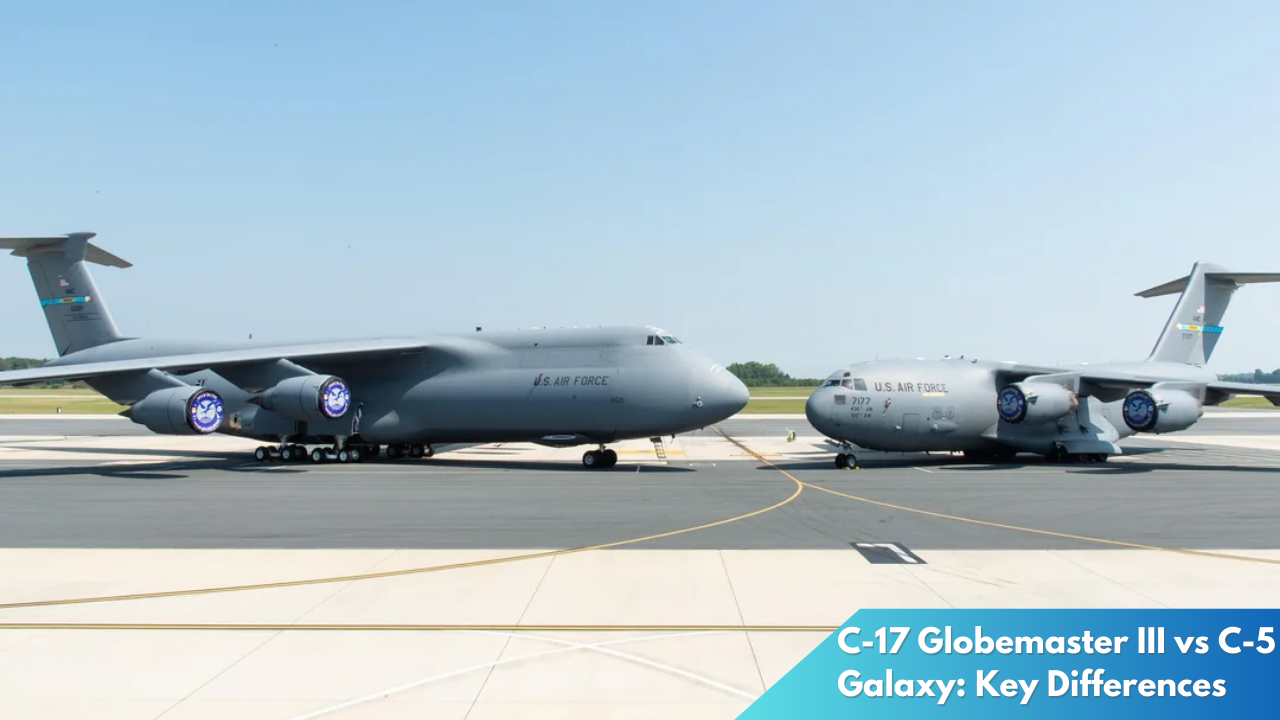
C-17 Globemaster III vs C-5 Galaxy: Key Differences
Two aircraft dominate the world of military heavy airlift: the Boeing C-17 Globemaster III and the Lockheed C-5 Galaxy. Both wear the same grey USAF livery, both have four engines and a T-tail, and both have moved mountains — literally and figuratively — across decades of combat and humanitarian operations.
But they are not interchangeable. They were built for different eras, different doctrines, and different definitions of what “moving cargo” really means. This guide breaks down every meaningful difference between the C-17 and C-5 so you can understand not just what separates them — but why those differences matter.
Quick Answer: C-17 vs C-5 Galaxy at a Glance
Before diving deep, here’s the short version:
- Need to carry more? Choose the C-5 Galaxy — it carries nearly twice the payload and flies almost twice as far without refueling.
- Need to go anywhere fast? Choose the C-17 Globemaster III — it can land on short, unpaved airstrips the C-5 could never approach, and it’s cheaper to maintain.
Now let’s go deeper.
Full Specs Comparison: C-17 Globemaster III vs C-5 Galaxy
| Specification | C-17 Globemaster III | C-5M Super Galaxy |
|---|---|---|
| Manufacturer | Boeing (formerly McDonnell Douglas) | Lockheed Martin |
| First flight | September 15, 1991 | June 30, 1968 |
| Entered service | 1995 | 1970 |
| Length | 174 ft (53 m) | 247 ft (75.3 m) |
| Wingspan | 169.8 ft (51.75 m) | 222.9 ft (67.9 m) |
| Max payload | 170,900 lb (77.5 tons) | 281,000 lb (127.5 tons) |
| Max takeoff weight | 585,000 lb | 840,000 lb |
| Range (with payload) | ~2,420 nautical miles | ~4,800 nautical miles |
| Cruising speed | 450 knots (520 mph) | 450 knots (520 mph) |
| Service ceiling | 45,000 ft | 35,000 ft |
| Engines | 4 ? Pratt & Whitney F117-PW-100 (40,440 lb thrust each) | 4 ? GE CF6-80C2L1F (51,000 lb thrust each) |
| Crew | 3 (pilot, co-pilot, loadmaster) | 7 (two pilots, two flight engineers, two navigators, loadmaster) |
| Troops capacity | Up to 102 paratroopers | Up to 345 troops (upper deck) |
| Min runway length | 3,500 ft — including unpaved strips | ~8,300 ft — paved runways only |
| Unit cost | ~$218–340 million | ~$167.7 million |
| Total produced | 279 | 131 |
| Operators | 8+ nations (USA, UK, Australia, Canada, India, Qatar, UAE, NATO) | USA only |
| Status (2025) | In active service | In active service (C-5M upgrade) |
1. Size and Physical Dimensions
The most immediate difference between the two aircraft is sheer physical scale. The C-5 Galaxy is enormous — at 247 feet long with a 222.9-foot wingspan, it is one of the largest military aircraft ever built. Its tail rises to 65 feet (almost six stories), and the cargo bay alone is 121 feet long — a fact often cited with the note that it’s actually one foot longer than the entire distance of the Wright Brothers’ first powered flight in 1903.
The C-17, while still a large aircraft by any standard, is considerably more compact at 174 feet long with a 169.8-foot wingspan. In terms of length, the C-17 is roughly comparable to a Boeing 757-300 — impressive until you park it next to a Galaxy and realize how much smaller it is.
This size difference is not cosmetic. It directly determines where each aircraft can operate, how much it can carry, and what infrastructure it requires on the ground.
2. Payload Capacity — The Biggest Gap
This is where the C-5 Galaxy’s advantage is most dramatic. With a maximum payload of 281,000 lb (127.5 tons), the Galaxy can carry nearly twice what the C-17 manages at 170,900 lb (77.5 tons).
What does that translate to in practical terms? The C-5 can carry:
- Two M1 Abrams main battle tanks
- Six AH-64 Apache attack helicopters
- A fully loaded CH-47 Chinook helicopter (entire, rotor blades and all)
- Outsized cargo that no other Western military transport can handle
The C-17 is no lightweight either — it can transport one M1 Abrams, three Apache helicopters, or carry 102 fully equipped paratroopers ready for a combat jump. But for true heavy strategic lift — moving an entire armored battalion’s worth of equipment across an ocean — the C-5 remains unmatched in the Western inventory.
3. Range — How Far Can They Go?
The C-5 Galaxy also wins on range by a large margin. With a ferry range of 4,800 nautical miles (5,500 miles) with a 120,000 lb payload, the Galaxy was specifically engineered for intercontinental strategic missions — getting heavy equipment from a US base to a distant theater without stopping.
The C-17’s range sits at approximately 2,420 nautical miles (2,785 miles) with a full payload. That’s still substantial — enough to cross the Atlantic with a combat load — but for the longest non-stop strategic hauls, the C-5 holds a clear advantage. Both aircraft are compatible with aerial refueling, which extends their range indefinitely for appropriately planned missions.
4. Airfield Flexibility — Where the C-17 Wins Decisively

Here is where the C-17 Globemaster III earns its reputation as the most versatile heavy airlifter in history. The C-17 can take off and land on runways as short as 3,500 feet (1,064 meters), including unpaved and semi-prepared surfaces. For comparison, the C-5 Galaxy requires a paved runway of at least 8,300 feet and needs extensive ground support infrastructure.
This is not a minor operational detail — it is a fundamental strategic capability. In Afghanistan, Iraq, and other conflict zones, the C-17 regularly delivered cargo and troops to forward operating bases with rough, short airstrips that would have been completely inaccessible to a C-5. The C-17 can also perform a reverse thrust landing, using engine thrust reversers while on the ground to taxi backwards — a critical ability when operating from tight airfields with no room to turn around.
Additionally, the C-17 can perform low-altitude parachute extraction (LAPES) and combat off-load operations, delivering cargo without coming to a complete stop. These tactical capabilities were simply not part of the C-5’s original design brief.
5. Speed and Service Ceiling
Despite their significant differences in size and purpose, both aircraft cruise at essentially the same speed: approximately 450 knots (520 mph / 830 km/h). This similarity is somewhat surprising given the C-5’s much larger engines, but both aircraft are optimized for efficient cruise rather than maximum speed.
Where they diverge is in service ceiling. The C-17 can reach 45,000 feet, while the C-5 is limited to approximately 35,000 feet. A higher service ceiling gives the C-17 more routing flexibility, the ability to fly above more weather systems, and a slight tactical advantage in certain threat environments.
6. Crew Requirements
The generational gap between these aircraft is reflected in their crew requirements. The older C-5 Galaxy requires a flight crew of seven people: two pilots, two flight engineers, two navigators, and a loadmaster. This crew size reflects 1960s aviation technology, when automated systems were less capable and human specialists were needed to manage complex navigation and systems monitoring tasks.
The C-17, designed with modern avionics and fly-by-wire control systems, operates with just three crew members: a pilot, co-pilot, and loadmaster. Fewer crew means lower operating costs, simpler logistics for aircrew training and scheduling, and reduced personnel risk in combat environments. This is one of the most significant operational efficiency advantages the C-17 holds over the Galaxy.
7. Cargo Loading Systems
Both aircraft feature nose-loading and rear-loading capabilities, but they approach cargo handling differently. The C-5 Galaxy has a distinctive “visor nose” — the entire nose tilts upward on hinges, creating a direct drive-on ramp for vehicles from the front. Combined with its rear ramp, this allows simultaneous front-and-rear loading, dramatically reducing turn-around time for large cargo operations.
The C-17 loads primarily through its rear ramp, which is wide enough to accommodate all standard military pallets and most military vehicles. Its cargo floor is designed to roll pallets quickly, and the entire system is engineered for rapid combat offload. In exercises, C-17 crews have demonstrated the ability to offload a full cargo load and be airborne again in under 20 minutes.
8. Avionics and Technology
The technology gap between these aircraft reflects their 25-year difference in design. The C-17 was built from the start with a modern digital glass cockpit, fly-by-wire controls, advanced weather radar, and a Head-Up Display (HUD) system for both pilots. Its maintenance diagnostic systems allow ground crews to identify faults quickly, reducing downtime.
The C-5 Galaxy, despite significant upgrades through the C-5M Super Galaxy modernization program (completed 2017), still incorporates elements of its original 1960s-era design philosophy. The upgrade added new GE CF6 engines, modern avionics, and improved reliability — but the aircraft’s fundamental architecture remains from an earlier era. The C-5M program has significantly improved mission-capable rates, which historically lagged behind the C-17.
9. Operating Cost and Maintenance
The C-5 Galaxy has historically suffered from lower mission-capable rates — a measure of how often an aircraft is actually ready to fly. Before the C-5M Super Galaxy upgrade program, the aircraft was available for missions only around 55% of the time. The upgraded C-5M has improved this significantly, but maintenance complexity and the age of the design continue to present challenges.
The C-17, with its modern design and simpler crew requirements, has demonstrated consistently higher availability rates. Its fly-by-wire systems reduce wear on mechanical components, and its engines are simpler to service than the C-5’s older powerplants were. Over a full lifecycle, the C-17’s lower operating costs partially offset its higher purchase price.
10. Export and Allied Use
One of the starkest contrasts between these two aircraft is their international footprint. The C-5 Galaxy has been operated exclusively by the United States Air Force — no foreign nation has ever purchased or operated it.
The C-17, by contrast, has been exported to eight countries including the United Kingdom, Australia, Canada, India, Qatar, the UAE, and through NATO’s Strategic Airlift Capability (SAC) program. This international adoption is a testament to the C-17’s versatility and its suitability for a wide range of national airlift needs. Qatar even operates its C-17 in a livery that mirrors Qatar Airways — arguably the most glamorous military cargo aircraft paint scheme in history.
Real-World Missions: Where Each Aircraft Proved Its Worth
The C-5 Galaxy in action
The C-5 Galaxy came into its own during the 1973 Arab-Israeli War (Operation Nickel Grass), when the US airlift command needed to resupply Israel with massive quantities of military equipment on extremely short notice. C-5s flew direct missions carrying tanks, artillery, ammunition, and aircraft parts at a rate that stunned observers — the operation delivered over 22,000 tons of materiel in just 32 days.
During the Gulf War (1990–91), C-5s were essential to building up the massive coalition force in Saudi Arabia, moving oversized equipment that simply could not have been transported any other way. More recently, during the 2021 Afghanistan evacuation, C-5s moved critical equipment and personnel as part of the broader airlift effort.
The C-17 Globemaster III in action
The C-17 became the workhorse of the post-Cold War era precisely because modern conflicts rarely happen in places with good airports. In Afghanistan, C-17s routinely landed at Bagram, Kandahar, and dozens of forward operating bases under threat, delivering supplies that kept coalition forces operational. In Iraq, they performed combat offloads — landing, unloading, and departing before enemy forces could effectively respond.
The C-17’s humanitarian record is equally impressive. After the 2010 Haiti earthquake, C-17s were among the first aircraft delivering aid to Port-au-Prince’s damaged airport, capable of operating from the degraded runway where larger aircraft could not. During COVID-19, C-17s airlifted medical supplies and equipment across the globe at speeds and to destinations impossible for commercial freight.
In 2010, during joint Army-Air Force airdrop exercises, a C-17 crew dropped 2,349 paratroopers over several days without a single intermediate stop — a demonstration of the aircraft’s endurance and sustained operational capability.
C-17 vs C-5 Galaxy: Which Is Better?
This is the wrong question — and that’s the point. The US Air Force operates both aircraft because they solve different problems.
The C-5 Galaxy is the right tool when you need to move the most weight the farthest distance in the fewest flights. If you need to transport two M1 Abrams tanks non-stop from Dover Air Force Base to a strategic hub in Europe or the Middle East, there is no substitute. Its unmatched payload capacity and intercontinental range make it irreplaceable for the heaviest strategic lift missions.
The C-17 Globemaster III is the right tool for almost everything else. It can go places the C-5 cannot reach, operate with a smaller crew, turn around faster, and perform tactical maneuvers that the Galaxy was never designed for. Its international adoption by allied air forces has also made it a cornerstone of coalition logistics — when NATO needs to move fast, C-17s from multiple nations can work together.
Together, they form a strategic airlift system that no other nation can match. The C-5 handles the impossible loads; the C-17 handles the impossible locations.
The Future: What Comes Next?
As of 2025, the US Air Force plans to continue operating both aircraft for the foreseeable future. The C-5M Super Galaxy upgrades have extended the Galaxy’s service life well into the 2030s. The C-17 fleet, while no longer in production (the last was delivered in 2015), remains a central pillar of USAF airlift with a planned service life through the 2040s.
No direct replacement for either aircraft is currently in development. The Next Generation Air Refueling System (NGAS) competition focuses on tankers, not airlifters, and the Air Force has indicated that both platforms will continue to evolve through upgrades rather than replacement in the near term.
Frequently Asked Questions
Is the C-17 bigger than the C-5?
No. The C-5 Galaxy is significantly larger in every dimension — it is 73 feet longer, has a 53-foot wider wingspan, and can carry nearly twice the payload of the C-17 Globemaster III.
Can the C-17 carry a tank?
Yes. The C-17 can carry one M1 Abrams main battle tank. The C-5 Galaxy can carry two simultaneously.
Which is faster, the C-17 or C-5?
They cruise at essentially the same speed — approximately 450 knots (520 mph). The C-17 has a higher service ceiling at 45,000 feet versus the C-5’s 35,000 feet.
How many C-17s are still in service?
As of 2025, approximately 260+ C-17s remain in active service across the US Air Force and allied nations. Production ended in 2015 with 279 total aircraft built.
Why does the C-5 have 7 crew members while the C-17 only needs 3?
The C-5 was designed in the 1960s, when automation was limited and required dedicated flight engineers and navigators. The C-17 uses modern fly-by-wire avionics that automate many of those functions, reducing the crew to three.
Which countries operate the C-17?
The C-17 is operated by the United States, United Kingdom, Australia, Canada, India, Qatar, the UAE, and through NATO’s Strategic Airlift Capability consortium. The C-5 Galaxy is operated exclusively by the United States Air Force.
What is the C-5M Super Galaxy?
The C-5M Super Galaxy is the modernized version of the original C-5, upgraded with new GE CF6-80C2L1F engines, modern avionics, and improved systems. The upgrade program was completed in 2017 and significantly improved the aircraft’s reliability and fuel efficiency.
Have a question about the C-17 or C-5 Galaxy that we didn’t cover? Drop it in the comments below.
